Debate and Impact: British Public Opinion, Limits of Propaganda at Home, and Contested Ideals
Revolutionary propaganda was powerful, but it did not convince everyone. Many colonists remained loyal to Britain. Loyalists argued that independence would lead to chaos, that the colonies were too weak to survive alone, and that British rule offered protection and stability. Some loyalists published their own pamphlets and newspaper essays, but they never matched the scale or energy of revolutionary print culture. As the war dragged on, loyalist voices were often silenced by intimidation, exile, or defeat ("The American Revolution"; Gould).
Among colonists who supported independence, revolutionary propaganda proved remarkably effective at shaping public opinion. Sales figures tell part of the story. Thomas Paine's Common Sense reached an estimated 500,000 readers in a population of 2.5 million, meaning roughly one in five colonists encountered it directly ("Common Sense By Thomas Paine"; Kiger). Paul Revere's Boston Massacre engraving circulated widely and became one of the most recognized images of the era, shaping perceptions of British cruelty far beyond Boston ("Paul Revere's Engraving"). Pamphlets and newspapers reprinted revolutionary arguments across colonies, creating what historians call a "public sphere" where political ideas traveled quickly and shaped collective action (Morgan; Warner).
The effectiveness of this propaganda can be measured in several ways. First, boycotts of British goods succeeded because printed appeals convinced merchants and ordinary families to participate, demonstrating coordinated public action across distant colonies ("The Revolutionary War"). Second, town meetings and public gatherings increasingly referenced arguments from pamphlets and newspapers, showing that print culture influenced how people spoke and thought about politics (Morgan). Third, by 1776, enough colonists had shifted toward supporting independence that the Continental Congress felt confident declaring it, a dramatic change from just a few years earlier when most still hoped for reconciliation ("The American Revolution"). While propaganda did not convince everyone, it succeeded in building a large enough coalition to sustain a revolutionary movement and eventually win independence.
British public opinion also shifted over time, though its political impact was limited by Britain's monarchical system. Unlike the colonies, where town meetings and local assemblies gave ordinary people some voice in politics, Britain remained a monarchy where King George III and Parliament held power regardless of popular sentiment. Early in the conflict, many in Britain supported strong measures to bring the colonies back under control. They saw the rebellion as a challenge to order and legitimate authority. Newspapers carried reports from America, and pamphlets openly mocked American concepts of liberty. Mainland British citizens viewed colonists as inferior subjects whose purpose was to provide wealth for the empire (Zielinski). But as the war continued and costs rose, enthusiasm faded even though public opinion had limited influence on policy. News of defeats at Trenton and Saratoga, mounting debt, and the entry of France and Spain into the war made the conflict unpopular. Voices opposing the war grew louder in Parliament, led by figures like Edmund Burke and William Pitt the Younger. By the 1780s, significant portions of the British public wanted peace, even if it meant recognizing American independence. However, the monarchy's structure meant that this shift in public opinion mattered less than it would have in a more representative system (Zielinski; Gould; "The Revolutionary War").
Interestingly, Britain produced relatively little mass propaganda aimed at its own public about the American conflict. While colonial printers churned out pamphlets, broadsides, and newspaper essays, British authorities did not launch a comparable campaign to shape opinion at home. This raises questions that remain open for research. Possible explanations include political priorities, the belief that the revolt would end quickly, established norms in British print culture, the limits of government censorship, and varying levels of public interest. Unlike the colonies, where print culture became a tool of mass mobilization, Britain may have relied more on traditional channels of authority and communication (Zielinski; Gould).
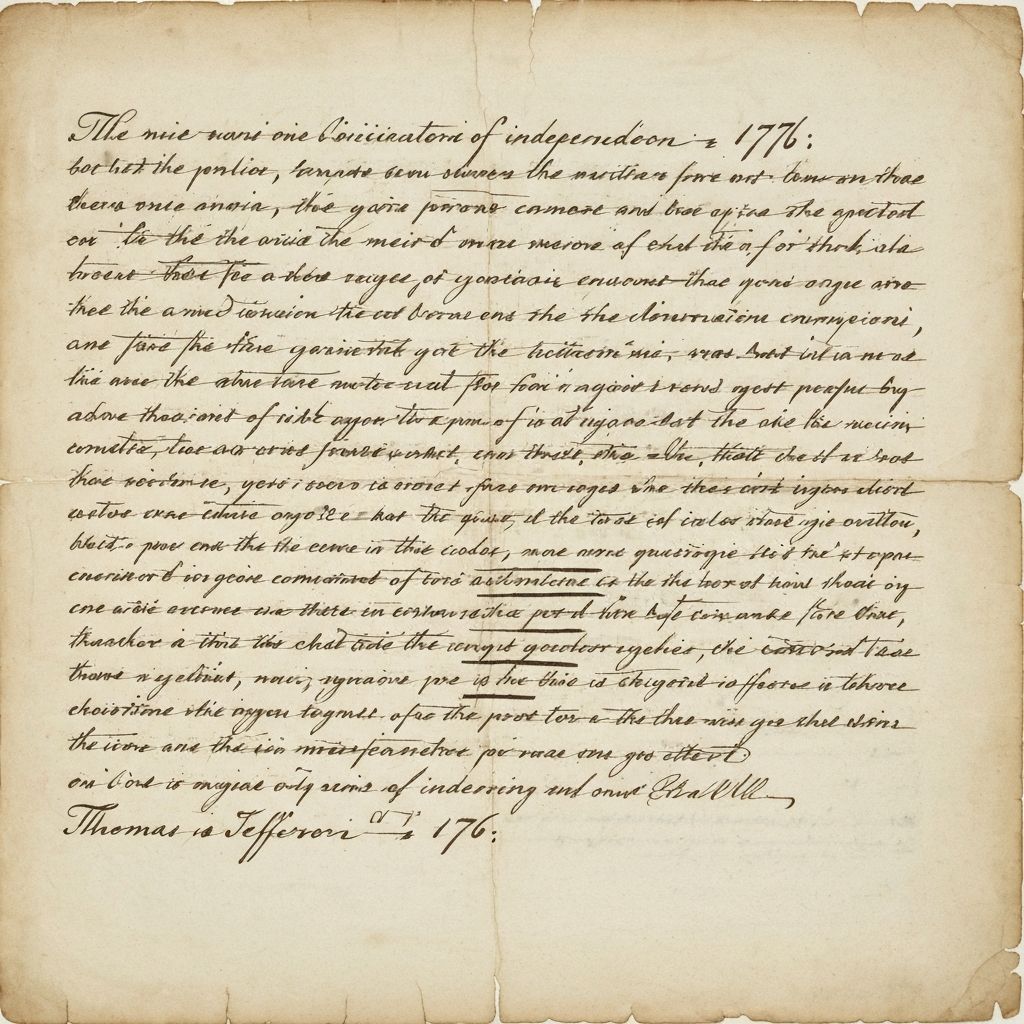
The limits of revolutionary propaganda also appear in internal contradictions. One striking example is Thomas Jefferson's deleted slavery paragraph from the Declaration of Independence. In his draft, Jefferson blamed King George for the slave trade, accusing him of waging "cruel war against human nature" by forcing slavery on the colonies. This passage used moral and commercial language to attack British policy. But it ignored the fact that colonial elites, including Jefferson himself, owned enslaved people and profited from slavery. The Continental Congress deleted the passage, likely because southern delegates objected and because it exposed uncomfortable contradictions in the revolutionary cause ("The Declaration of Independence"; Holton).
This example shows how propaganda works. Revolutionary leaders framed their arguments in terms of natural rights and liberty, but they did not apply those principles equally. Slavery continued in most states after independence. Native Americans were largely excluded from revolutionary promises of self-government and faced continued violence and dispossession. Women gained no new political rights. These contradictions reveal that revolutionary propaganda was selective. It united white male colonists around shared grievances and ideals but left other forms of oppression intact (Holton; Parkinson).
Historians have debated the broader impact of the Revolution. Frederick B. Tolles and other scholars argue that the Revolution was more than a political break. It was a social movement that reshaped laws, religious institutions, and class relations. The Revolution weakened established churches in some states, expanded access to property, and encouraged challenges to traditional hierarchies. Yet these changes were uneven and contested. For every gain, there were limits and exclusions. Tolles notes that the Revolution's ideals of equality and liberty took generations to expand beyond their original, narrow application (Tolles; Parkinson).
The power of print to shape public opinion remains relevant. Just as colonial printers chose which voices to amplify and which to silence, modern media makes similar choices. Revere's engraving distorted facts to create a compelling narrative. Paine's Common Sense used plain language and emotional appeals to make independence seem inevitable. Jefferson's deleted paragraph shows how leaders frame policy while avoiding contradictions. These strategies appear in every period. Understanding how they worked in the Revolution helps us think critically about how images and words shape action today.
The American Revolution succeeded because it was not just a military struggle but a battle for public opinion. Print culture gave colonists tools to debate, organize, and imagine a shared future. Propaganda unified the movement, but it also simplified and excluded. By studying both the power and limits of revolutionary communication, we can better understand how ideas spread, how movements form, and how societies change. The Revolution shows that words and images can inspire unity and action, but they also carry the contradictions and blind spots of those who create them (Gould; Tolles; Morgan).
Revolutionary-era propaganda demonstrates that public opinion is not simply a reflection of events but is actively shaped by how those events are presented. Through strategic use of print, image, and rhetoric, colonial leaders transformed scattered grievances into a unified movement, proving that communication can be as powerful as military force in achieving political change.